
Hybrid battery problems rarely give you much warning. One morning your Toyota Prius is running fine, and the next you're stranded in a Phoenix parking lot with a red triangle on your dashboard and no idea what went wrong. For drivers in the Valley, this scenario is more common than you'd think, especially during summer months when temperatures regularly push past 110°F. This guide walks you through every practical step you need to monitor your hybrid battery at home, catch problems early, and avoid the kind of expensive emergency that ruins your week.
Table of Contents
- Why battery health monitoring matters in Phoenix
- Tools and requirements for at-home battery checks
- Step-by-step process to monitor battery health
- How to interpret results and what to do next
- A local expert's take: What Phoenix hybrid owners get wrong about battery health
- Hybrid Matters: Fast, reliable mobile battery replacement in Phoenix
- Frequently asked questions
Key Takeaways
| Point | Details |
|---|---|
| Arizona heat risks | Phoenix’s extreme temperatures demand extra vigilance with hybrid batteries. |
| Easy at-home checks | With basic tools, most hybrid owners can monitor key battery health markers. |
| Know warning signs | Recognizing dashboard alerts and performance drops can prevent bigger issues. |
| Mobile help available | Convenient mobile battery replacement services make expert help fast and easy. |
Why battery health monitoring matters in Phoenix
Phoenix isn't just hot. It's consistently, relentlessly hot in a way that directly shortens the life of your hybrid battery. Extreme heat accelerates battery degradation by breaking down the chemical compounds inside each battery cell faster than in cooler climates. A battery that might last 150,000 miles in Seattle could start showing serious wear at 80,000 miles here in Arizona.
For owners of Toyota Prius, Camry Hybrid, Lexus ES or RX, and Nissan Altima Hybrid models, the symptoms often look similar:
- Reduced fuel economy, sometimes dropping 5 to 10 MPG below normal
- The hybrid battery warning light or red triangle appearing on the dashboard
- Increased engine noise as the gas engine compensates for a weak battery
- Sluggish acceleration, especially from a full stop
- The battery charge gauge fluctuating wildly or staying low
These symptoms don't always appear at once. Often, one or two show up months before full failure. That window is exactly when monitoring pays off.
"Catching a weak battery block early can save you hundreds of dollars and prevent a complete battery failure at the worst possible time."
Regular monitoring gives you three real advantages. First, you avoid surprise breakdowns. Second, you can plan and budget for replacement on your schedule instead of an emergency timeline. Third, you preserve your vehicle's overall reliability, which matters when your hybrid is your daily driver.
Arizona hybrid owners also face a specific challenge: the heat doesn't let up. Even in October, daytime temps can hit 95°F. That means the signs of hybrid battery failure can appear year-round, not just in summer. Staying proactive with regular checks is the only reliable way to stay ahead of the problem.
Tools and requirements for at-home battery checks
Understanding the local risks, it's smart to gather the right tools before starting. The good news is that you don't need a garage full of expensive equipment. A few targeted tools are all it takes.
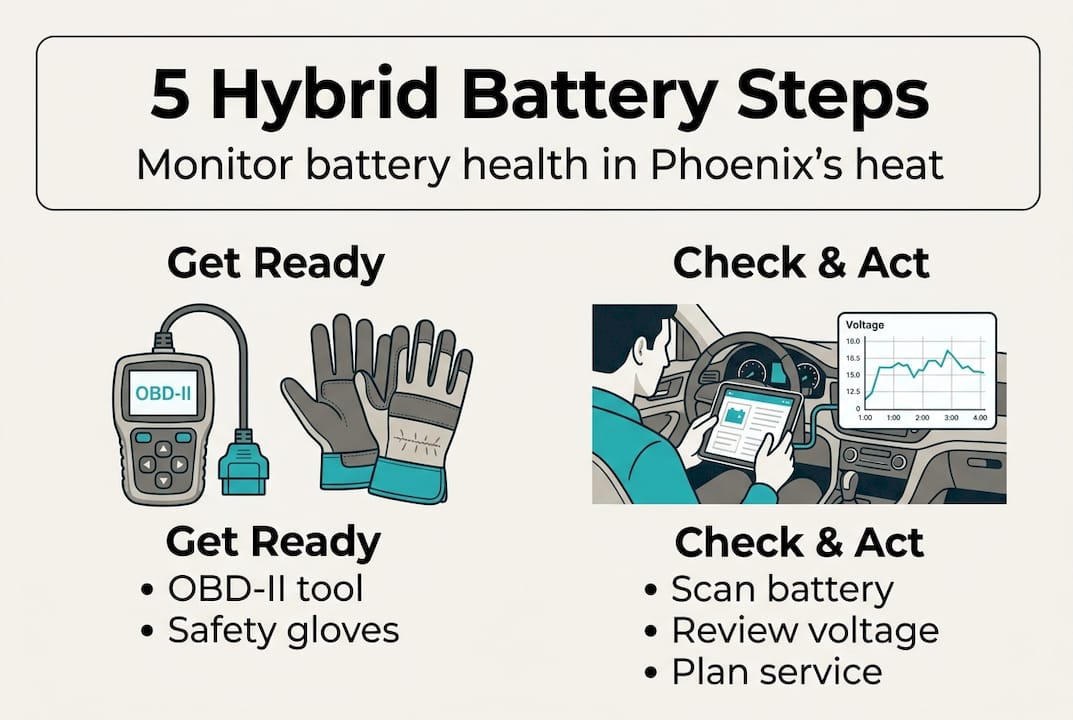
Essential tools for at-home hybrid battery monitoring:
- OBD-II scanner: This is the most important tool. It plugs into the diagnostic port under your dashboard and reads live data from your battery management system.
- Compatible smartphone app: Apps like Torque Pro, Dr. Prius, or Leaf Spy (for Nissan) translate raw scanner data into readable battery health information.
- Safety gloves: Hybrid battery systems operate at high voltage. Always wear insulated gloves when working near battery components.
- A fully charged phone or tablet: You'll need it to run the app and record your readings.
Diagnostic tools for hybrid batteries have become much more accessible in recent years, and many OBD-II scanners now cost under $30. Testing your hybrid battery at home is now a realistic option for most owners.

Here's a quick reference for tool compatibility by model:
| Vehicle Model | Recommended App | OBD-II Protocol |
|---|---|---|
| Toyota Prius (2004 to 2023) | Dr. Prius / Torque Pro | CAN Bus |
| Toyota Camry Hybrid | Torque Pro | CAN Bus |
| Lexus ES / RX Hybrid | Techstream (dealer) or Torque Pro | CAN Bus |
| Nissan Altima Hybrid | Leaf Spy / OBD Fusion | CAN Bus |
Before you connect anything, park on a flat surface, turn off the vehicle, and wait at least five minutes. This lets the battery management system settle into a resting state, which gives you more accurate readings.
Pro Tip: Toyota and Lexus vehicles respond best to manufacturer-specific apps like Dr. Prius, which can display individual battery block voltages. Generic OBD apps miss this detail and may give you an incomplete picture of battery health.
Step-by-step process to monitor battery health
With the tools assembled, follow these steps to effectively monitor your hybrid battery's health at home.
-
Park and prepare. Turn off the vehicle and open the windows slightly to allow heat to escape. If you're in Phoenix, try to do this check in the early morning before the car heats up in the sun.
-
Plug in your OBD-II scanner. Locate the OBD-II port, usually found under the driver's side dashboard near the steering column. Plug in the scanner firmly.
-
Launch your app and connect. Open your chosen app on your phone and pair it with the scanner via Bluetooth or Wi-Fi. Most apps walk you through this in under two minutes.
-
Read battery block voltages. Navigate to the hybrid battery section of the app. You're looking for individual block voltages. On a healthy Prius battery, each block should read between 7.4V and 8.4V. Blocks reading below 7.0V or significantly different from others are a red flag.
-
Check the state of charge (SOC). A healthy hybrid battery typically shows an SOC between 40% and 80% during normal operation. Values consistently at the extremes suggest the battery is struggling to regulate itself.
-
Note any active DTC codes. DTC stands for Diagnostic Trouble Code. Codes like P0A80 on a Toyota indicate battery degradation. Understanding DTC codes for hybrid vehicles in Phoenix is key to interpreting what your scanner finds.
-
Record your results. Write down or screenshot your readings. Tracking changes over time is more useful than a single snapshot.
A systematic approach to battery assessment ensures you're not missing anything. Rushing through the steps or skipping the recording phase defeats the purpose.
Pro Tip: In Arizona, heat soaks into your car fast. If you run this check after the car has been sitting in direct sun, your readings may be skewed. Always check in shade or early morning for the most accurate data.
| Reading Type | Healthy Range | Concerning Range |
|---|---|---|
| Battery block voltage | 7.4V to 8.4V | Below 7.0V or uneven spread |
| State of charge (SOC) | 40% to 80% | Below 20% or above 90% consistently |
| Battery temperature | Below 95°F | Above 110°F at rest |
How to interpret results and what to do next
Now that you've completed your monitoring steps, let's make sense of what those numbers and codes mean and determine your best next move.
Healthy battery data looks consistent. All block voltages fall within a tight range, the SOC moves smoothly during acceleration and braking, and no DTC codes are present. If that's what you see, you're in good shape. Schedule your next check in six months.
Concerning patterns look different:
- One or more battery blocks reading 0.5V or more below the others. This is called cell imbalance and it's one of the earliest signs of failure.
- SOC dropping rapidly during short drives. This means the battery isn't holding a charge effectively.
- Repeated DTC codes, especially P0A80. This Toyota-specific code directly flags battery deterioration.
- Battery temperature staying high even after the car cools down. In Phoenix, this can accelerate wear rapidly.
"A single weak block can drag down the entire battery pack, so catching it early is the difference between a repair and a full replacement."
If your results show multiple weak battery blocks, professional diagnostics are the right next step. At-home tools give you a solid picture, but a licensed technician can run deeper tests that confirm whether you need a repair or a full replacement.
For common hybrid battery issues caught early, some owners manage with reconditioning services. For more advanced degradation, replacement is the more reliable path.
Pro Tip: In Arizona's climate, we recommend checking battery health every six months, ideally in March before summer and in October after the heat breaks. This timing gives you the clearest picture of how the summer affected your battery. You can also review guidance on maintaining battery health between checks.
A local expert's take: What Phoenix hybrid owners get wrong about battery health
Most Phoenix hybrid owners know the heat is hard on batteries. What they get wrong is assuming that dashboard warning lights are an early warning system. They're not. By the time a warning light appears, the battery has often been degrading for months. The light is a late signal, not an early one.
We've seen this pattern repeatedly: a driver waits for the red triangle, then discovers their battery is already in advanced failure. At that point, options narrow and costs rise. Regular at-home checks using the steps above give you months of lead time that a dashboard light never will.
Another common mistake is skipping summer checks because "the car seems fine." Phoenix summers stress hybrid batteries harder than any other season. That's exactly when you should be checking, not assuming. A quick look at Phoenix summer hybrid tips can help you build the right habits before temperatures peak. DIY monitoring takes about 15 minutes. That's a small investment to protect a battery that can cost $1,500 or more to replace.
Hybrid Matters: Fast, reliable mobile battery replacement in Phoenix
If your monitoring steps reveal a battery that needs service or replacement, you don't have to deal with dealership wait times or tow trucks.

Hybrid Matters specializes in mobile hybrid battery replacement across the Phoenix metro area, covering Toyota Prius, Camry Hybrid, Lexus models, Nissan Altima Hybrid, and more. Our licensed technicians come to your home, office, or wherever your car is parked. Most replacements are done in under two hours with no mobile service fee within 25 miles. We serve drivers across the Valley, including Chandler hybrid battery service, Mesa battery replacement, and the broader Phoenix mobile battery replacement area. Warranties up to one year are included.
Frequently asked questions
What tools do I need to check my hybrid battery health at home?
You'll need an OBD-II scanner and compatible app along with basic safety gear like insulated gloves to safely read your battery's live data.
How often should I monitor my hybrid battery in Phoenix?
Check every six months, especially before summer, since Phoenix heat accelerates battery wear faster than in most other U.S. cities.
What are warning signs my hybrid battery is failing?
Reduced MPG, dashboard alerts, and sluggish acceleration are the most common early hybrid battery failure signs to watch for.
Can I drive with a bad hybrid battery in Arizona's summer?
Driving with a failing battery in extreme heat increases the risk of sudden failure and can leave you stranded, so it's best to seek service as soon as possible.